AWS or Azure? It’s the first question everyone asks when they’re thinking about cloud migration, and I get it - you don’t want to pick wrong. But here’s the thing I learned after about 120 migrations (honestly lost count after 100): there’s no universal “better” platform.
What there is? A better platform for your specific situation. And that usually comes down to three things that have nothing to do with feature lists.
Let me walk you through how I help Australian businesses make this call. No vendor marketing BS - just what I’ve seen actually work over 11 years doing this.
Quick Reality Check: What Actually Matters
Before we dive into speeds and feeds, let me save you some time. Here’s what I’ve learned determines platform choice 80% of the time:
Do you run a lot of Microsoft stuff? Windows Server, SQL Server, Active Directory, Office 365? If yes, Azure will almost certainly be cheaper - sometimes 40-50% cheaper - because of license portability. This alone tips the scales for most traditional enterprises.
Are you a startup or tech company? AWS probably makes more sense. More services, better pricing for variable workloads (Spot instances are amazing), and frankly, easier to hire people who know AWS in the startup world.
Do you need government compliance? Azure has better IRAP coverage in Australia. Not a little better - significantly better, especially if you need PROTECTED level certification.
Those three questions solve about 70% of cases. The other 30%? That’s where it gets interesting.
The Comparison Everyone Wants (But Maybe Doesn’t Need)
Look, I could write 10,000 words comparing every service. But you’d still be confused because both platforms can do basically everything the other can do. The differences are in how they do it and what it costs.
| What You Actually Care About | AWS | Azure |
|---|---|---|
| Microsoft integration | Meh, works but clunky | Native, seamless |
| Government compliance (IRAP) | Good (~60 services) | Better (~80 services) |
| Service selection | More (200+) | Plenty (150+) |
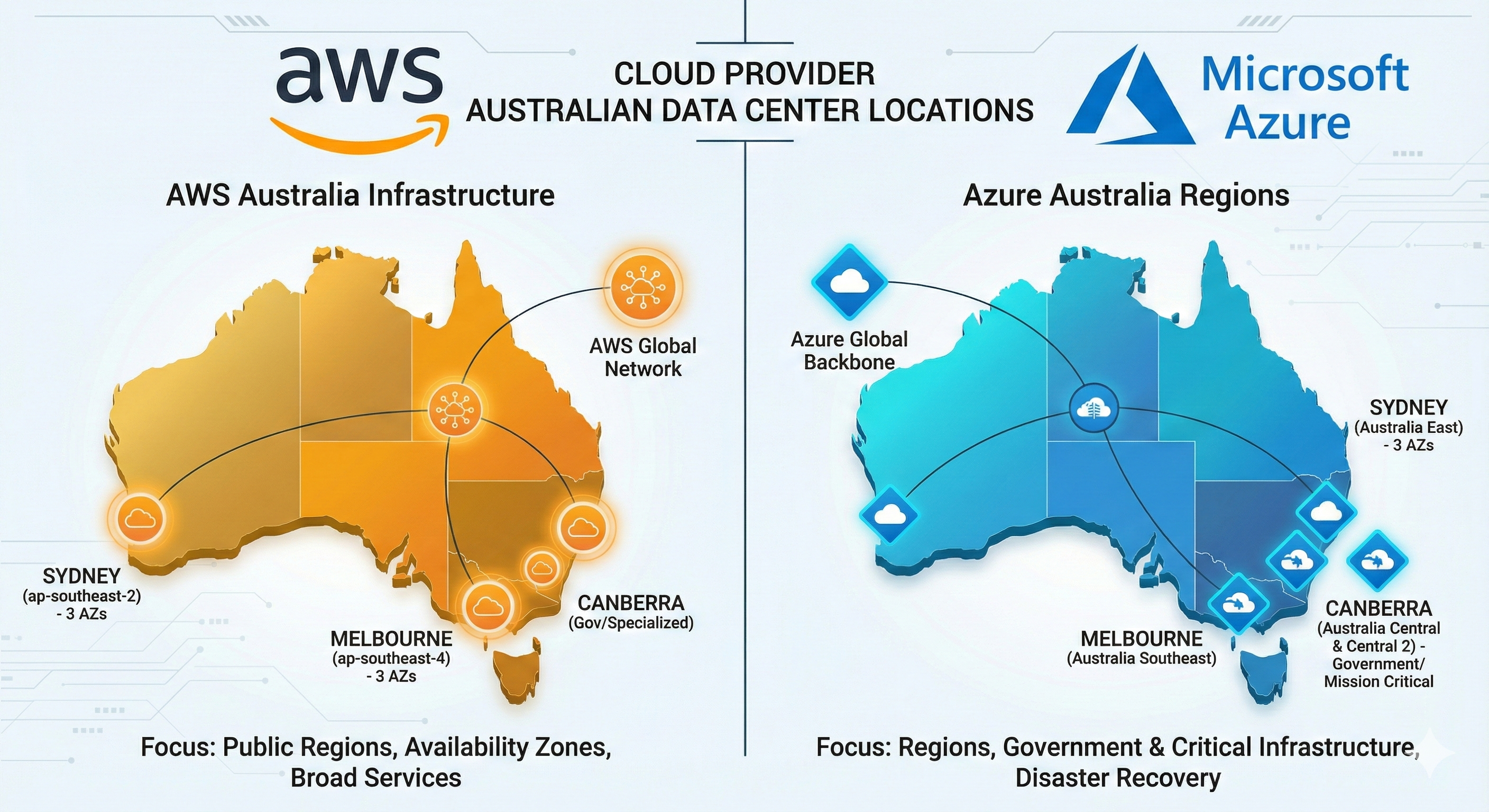
| Australian regions | Sydney, Melbourne | Sydney, Melbourne, Canberra |
| Startup-friendly pricing | Better (Spot instances) | Adequate |
| Enterprise licensing deals | Standard discounts | Often much better with EA |
| Learning curve | Steeper | Easier if you know Windows |
The reality? Both work fine. I’ve never had a client say “we chose wrong” - though I’ve had plenty say “we wish we’d optimized sooner” (different problem).
When AWS Actually Makes Sense
I’m not here to sell you AWS, but there are definitely scenarios where it’s the right call.
You need the latest ML/AI stuff. AWS gets new services faster. SageMaker is legitimately more mature than Azure ML. If you’re doing serious machine learning work, AWS typically has better tools. Melbourne fintech needed real-time fraud detection - worked with them last year. SageMaker plus Kinesis was just better at the time for their streaming setup. Azure’s caught up in some areas since then, but if you’re on the bleeding edge, AWS usually gets there first.
Variable workloads that can leverage Spot pricing. This is huge and underutilized. Spot instances are AWS spare capacity sold at 70-90% discounts. Sounds too good to be true, right? Catch is AWS can reclaim them with 2 minutes notice. But if you’ve got batch processing, rendering, or anything that can handle interruption? The savings are insane.
$6,100 down to $900 monthly. Brisbane logistics company processing overnight data - same work, 85% cheaper with Spot instances. Azure has Low Priority VMs (similar concept) but AWS’s Spot marketplace is more mature with better availability.
You’re hiring from the startup world. More developers know AWS because more startups use AWS. Not scientific, just reality. If you’re trying to hire cloud engineers in Melbourne or Sydney, you’ll find more AWS experience than Azure in the under-35 crowd. Older, enterprise-background folks? More Azure/Microsoft experience.
Your workload is AWS-specific. Some things work better on AWS. Lambda for serverless (more mature). DynamoDB if you need that specific NoSQL flavor. If you’re already using AWS-specific services in dev or testing, migration path is obvious.
When Azure Actually Makes Sense
Most Australian mid-market companies I work with end up on Azure. Not because it’s “better” - because the math works out better for typical enterprise setups.
You’ve got Microsoft licensing. This is the big one. If you’ve got Windows Server and SQL Server licenses already - either through an EA or just purchased - Azure Hybrid Benefit changes everything. You can use those licenses in Azure. Can’t do that on AWS.
National healthcare provider scenario: already paying for Windows Server licenses. In AWS, they’d pay full Windows licensing on top of compute. In Azure with Hybrid Benefit? Just compute. Saved them about $180K annually. Migration paid for itself in 8 months.
Government or highly regulated industry. Azure has more IRAP-certified services at PROTECTED level. If you’re in government, healthcare, or finance, this matters. A lot. State government agency case - they needed PROTECTED certification for case management system. Azure had all services certified. AWS? Would’ve needed hybrid approach with some services not certified. Deal breaker for that project.
Hybrid cloud requirements. If you need genuine hybrid (cloud + on-premise working together), Azure Stack and Azure Arc are legitimately better than AWS Outposts. This matters for mining companies, manufacturers with edge computing needs, or anyone who can’t move everything to cloud yet.
Does this actually work for terrible connectivity scenarios? Mining company needed edge computing at remote sites - intermittent internet at best. Azure Stack HCI runs Azure services locally, syncs when connected. AWS Outposts would’ve required constant connectivity and higher minimum commitment. Not workable for their situation.
Your team knows Microsoft inside out. If your IT team are Windows/SQL Server/Active Directory experts, Azure has a much gentler learning curve. They can leverage existing knowledge. AWS is more different from what they know - means more training time and higher risk during migration.
The Cost Question Everyone Gets Wrong
“Which is cheaper?” Wrong question. Both are expensive if you don’t optimize, both are reasonable if you do.
Here’s what I’ve actually seen:
Pure compute, no Microsoft licensing? AWS is usually 5-10% cheaper for equivalent workloads. Not enough to matter much.
Windows + SQL workloads with existing licenses? Azure is 30-55% cheaper with Hybrid Benefit. This is huge and tips most enterprise decisions.
Development/test environments? AWS Spot instances win by a mile if you architect for them. 60-70% cheaper than Azure for workloads that can handle interruption.
Enterprise with EA? Azure often better. Microsoft gives better volume discounts in EAs than AWS, and you can bundle Azure spend with other Microsoft products.
Hidden costs? Both have them. AWS data egress fees surprise everyone. Azure’s inter-zone bandwidth costs add up. Storage transaction fees on both platforms catch people off guard.
Sydney retailer learned this one the hard way - migrated to AWS, first month’s bill was $3,000 over projections. Why? Data egress costs nobody had modeled properly. Product images going out to customers. We fixed it with CloudFront CDN (reduced to $800), but they should’ve caught it during planning.
The Australian Context That Actually Matters
Some things are different in Australia. Not everything, but enough to matter.
Data sovereignty is real. Both AWS and Azure can keep your data in Australia. But you need to configure it properly - defaults might store logs, backups, or metadata overseas. I’ve seen companies get surprised during compliance audits.
IRAP certification matters for some industries. If you’re in government, healthcare, or finance, you might need this. Azure has broader IRAP coverage. Not opinion - just count the certified services. Azure wins on this metric.
Support timezones matter more than you think. When something breaks at 3 AM Sydney time, you want support that’s awake. Both have Australian support, but response quality varies by support tier. Enterprise support is better for both, but not cheap ($1,000-15,000/month depending on spend).
Currency risk is real. Both price in USD. Australian businesses face currency fluctuation risk. I usually tell people to budget 10-15% buffer for forex movement. Some Azure partners offer AUD pricing if that matters to you.
Local partner ecosystems differ. AWS has been here since 2012, Azure since 2016. AWS has deeper partner network in tech/startup world. Azure has deeper enterprise/consulting partnerships. Matters if you’ll need local help.
How I Actually Help Clients Decide
When someone asks me AWS or Azure, here’s what I walk through:
First question: What Microsoft stuff do you run?
Count your Windows Server licenses, SQL Server licenses, and think about your Active Directory setup. If the answer is “a lot,” Azure probably saves you 20-40% right there. If the answer is “not much” or “we’re mostly Linux,” AWS might make more sense.
Second question: What does your team know?
Your existing team matters more than perfect platform choice. A good migration to your team’s stronger platform beats a perfect migration to a platform they’ll struggle with. Retraining costs money and introduces risk.
Third question: What’s your workload pattern?
Steady, predictable usage? Both platforms work fine, slight Azure edge on enterprise pricing. Variable with burst capacity needs? AWS Spot pricing might save you serious money. Hybrid with some on-premise? Azure’s hybrid story is stronger.
Fourth question: Any compliance requirements?
Government work? Healthcare? Finance? Check IRAP certification requirements. Azure probably wins. Standard business? Doesn’t matter much.
Fifth question: How fast are you growing?
Startups that might 10x in a year? AWS’s service breadth and Spot pricing help with growth. Established business with predictable growth? Azure’s Reserved Instances and EA discounts work well.
Those five questions get to the right answer faster than comparing feature lists.
Real Client Decisions (Names Changed, Numbers Real)
Three actual decisions from last year show how this plays out:
Melbourne Healthcare Provider → Azure
They had 40 Windows Server VMs, 8 SQL Server databases, Active Directory with 200 users, existing Microsoft EA.
Why Azure? License portability alone saved $180K annually. Math was obvious before looking at anything else. IRAP certification requirement was satisfied automatically. Migration cost: $220K. Payback period: 14 months.
AWS would’ve worked technically. But it would’ve cost them an extra $220K yearly. Math doesn’t lie.
Sydney Fintech Startup → AWS
Real-time fraud detection requirements, variable load (3x spike during trading hours), DevOps culture, zero Microsoft investment.
Why AWS? SageMaker for ML was ahead at the time. Spot instances for variable batch processing saved $5K monthly. Team already knew AWS from previous roles. Lambda for serverless was more mature.
Could Azure have worked? Probably fine. But AWS fit their specific needs and team skills better.
Brisbane Manufacturer → Azure (Interesting Case)
Mostly Linux workloads, minimal Windows stuff, no significant Microsoft investment.
Why Azure then? Their CTO knew Microsoft way better than AWS. We almost convinced them AWS made more sense for their workload mix. But team comfort won out.
One year later? They’re happy with the choice. Could’ve gone AWS and been equally happy. Sometimes team knowledge matters more than perfect technical fit.
Multi-Cloud: Don’t Do It (Probably)
Every company asks about multi-cloud. “Should we use both?”
Short answer: No, unless you’re huge (1,000+ employees) or have regulatory requirements forcing it.
Multi-cloud sounds good in theory: “Best of both worlds!” Reality: worst of both worlds. You’re learning two platforms, maintaining two sets of security configurations, paying for expertise in both, and complex cost management.
I’ve seen companies try multi-cloud and regret it. The overhead kills you. You’re much better off picking one platform and getting really good at it.
Only exception: if you’re big enough to have separate teams per platform, or regulations require geographic/provider redundancy. For mid-market Australian companies? Pick one, optimize it, profit.
Data Sovereignty and Compliance (The Boring But Important Bit)
Both AWS and Azure can keep your data in Australia. Both have Sydney and Melbourne regions. Azure has Canberra region specifically for government work.
But here’s what catches people: you need to explicitly configure region restrictions. Default settings might store certain data (logs, backups, some metadata) outside Australia. Seen this bite companies during compliance audits.
For regulated industries:
- Healthcare: Check service-specific IRAP certifications
- Finance: APRA has specific requirements, both platforms can meet them but check carefully
- Government: Azure typically easier due to broader IRAP coverage and Canberra CDC
If you’re handling sensitive data, talk to someone who knows Australian compliance. Don’t assume cloud provider defaults meet your requirements.
What If You’re Already on One Platform?
“We’re on AWS, should we switch to Azure?” or vice versa.
Usually: No. Unless something’s seriously wrong or fundamentally changed.
Switching platforms is expensive. Like really expensive. 3-6 months minimum for any meaningful workload, plus retraining, plus re-architecting anything using platform-specific services. You’re essentially doing another migration.
When switching makes sense:
- Major licensing change (bought by Microsoft-heavy company)
- 50%+ cost difference that persists even after optimization
- Compliance requirement only one platform can meet
- Fundamental capability gap for critical workload
When to stay put:
- Things are working fine
- Cost difference is under 30%
- Team has deep expertise in current platform
- No compelling business reason
I’ve had clients ask about switching to save 20%. My advice? Don’t. Optimize what you have instead. Usually find 20-40% savings through optimization anyway, without the risk and disruption of switching.
So What Should You Do?
Here’s my actual advice:
If you have significant Microsoft licensing: Start with Azure. Do the math on Hybrid Benefit. If savings are 30%+, Azure wins. If savings are under 20%, might still go AWS for other reasons.
If you’re a startup or tech company: Probably AWS. More services, better Spot pricing, easier to hire for. Unless you’re already in Microsoft ecosystem.
If you’re in government or regulated industry: Check IRAP requirements first. Might force your hand. If not, go back to the Microsoft licensing question.
If you need hybrid cloud: Azure’s hybrid story is genuinely better. Stack and Arc work well.
If you’re not sure: Pick based on what your team knows. Retaining knowledge beats perfect platform choice.
And honestly? Both platforms work fine. I’ve never had a client seriously regret their platform choice - though plenty wish they’d optimized costs sooner (different problem, both platforms have that issue).
The real risk isn’t picking wrong. The real risk is staying on legacy infrastructure while your competitors move to cloud and gain agility advantages.
Get Help Making the Decision
Look, this is a big decision and there’s no shame in wanting expert input. I offer free 30-minute platform assessment calls where we’ll:
- Review your current environment (what you’re running)
- Talk through your Microsoft licensing situation
- Discuss your team’s skills and comfort level
- Calculate realistic TCO for both platforms
- Give you an honest recommendation (might be neither - some companies shouldn’t migrate yet)
No sales pitch. No pressure. Just honest advice based on doing this 120+ times.
Worst case? You spend 30 minutes talking with someone who’s done this before and get a clearer sense of what makes sense for you.